Manufacturer Of High Quality Data Cable

Manufacturer Of High Quality Data Cable
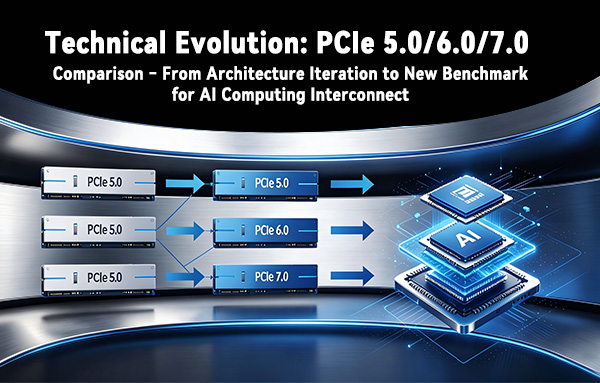
With the rapid popularization of AI large models, high-performance computing and ultra-large-scale data centers, high-speed I/O interconnection has become the core bottleneck of computing infrastructure. As a universal high-speed bus standard, PCIe has evolved through multiple generations. The transition from PCIe 5.0 to 6.0 achieves underlying architecture reconstruction, and PCIe 7.0 moves towards physical limit speed increase. These three generations are not simple rate doublings, but comprehensive differentiations in technical roadmap, signal mechanism and application scenarios. Based on official specifications and engineering practices, this article deeply analyzes the core differences of the three generations of PCIe, providing an authoritative reference for high-speed interconnection solution selection.
Item | PCIE5.0 | PCIE6.0 | PCIE7.0 |
Data Rate | 32 GT/s | 64GT/s | 128 GT/s |
x16 Bidirectional Bandwidth | 128 GB/s | 256 GB/s | 512 GB/s |
Modulation | NRZ (PAM2) | PAM4 | PAM4 |
Nyquist Frequency | 16 GHz | 16 GHz | 32GHz |
cEncoding Scheme | 128b/130b | 1b/1b Flit | 1b/1b Flit |
FEC | None | Lightweight FEC | Enhanced FEC + Security |
Transfer Unit | Variable-length packets | Fixed 256B F1it | Fixed 256B F1it |
BER Standard | BER ≤ 1E-12 | FBER ≤ 1E-6 | FBER ≤ 1E-6 |
Moderate | High | Extremely Hi | Extremely High |
Deployment Stage | Mainstream in data centers | Next-generation mainstream | Future R&D and deployment |
PCIe 5.0 is the final finale of the traditional NRZ encoding, and it is the standard interconnection solution for current AI servers, high-end storage and 400G network cards. It inherits the two-level transmission of PCIe 3.0/4.0, transmitting 1 bit per signal cycle. The signal eye diagram is complete with strong anti-interference ability. The 15 mV eye height and 9.375 ps eye width retain sufficient hardware margin. The 36 dB channel loss budget can adapt to conventional PCB and backplane transmission, and can be deployed stably without complex retimers.
At the protocol layer, 128b/130b encoding is adopted without FEC. Ultra-low bit error rate is achieved by native signal quality, with low latency and strong compatibility. Equalization only requires 3-tap DFE and basic CTLE, with moderate design threshold and controllable cost. It is the best solution balancing performance, stability and deployment cost, covering full scenarios from consumer flagship to enterprise-level computing.
If previous generations were iterative under the same architecture, PCIe 6.0 is a comprehensive reconstruction from physical layer to protocol layer, regarded as the largest technological fault in the past decade, and the boundary between traditional interconnection and AI-era interconnection.
On the premise of unchanged 16 GHz frequency, PAM4 four-level modulation realizes 2 bits per cycle, doubling the rate to 64 GT/s. The cost is greatly reduced signal margin: top eye height only 6 mV, eye width 3.125 ps, channel loss budget tightened to 32 dB, putting strict requirements on PCB materials, impedance control, connectors and shielding.
It abandons traditional variable packets and adopts 256-byte fixed Flit frames to realize 1b/1b lossless encoding, eliminating encoding overhead and reducing delay jitter. Lightweight FEC is added to exchange link stability with small delay, which is a necessary compromise for high-speed transmission.
CTLE is upgraded to 6-pole/3-zero, DFE taps surge from 3 to 16. High-performance retimers, low-loss materials and precise wiring become necessary, significantly increasing design and cost thresholds, specially built for 800G interconnection and large-scale GPU clusters.
PCIe 7.0 fully inherits the mature architecture of 6.0 without underlying reconstruction. The core upgrade is to double the Nyquist frequency to 32 GHz. Combined with PAM4, it achieves 128 GT/s rate and x16 bidirectional 512 GB/s extreme bandwidth, targeting 1.6T Ethernet, AI large model clusters, quantum computing and global supercomputing.
The signal margin is further reduced, and the channel loss budget approaches the physical limit of copper cables. Copper transmission distance is strictly limited. The large-scale deployment in the future will inevitably rely on co-packaged optics and optical fiber interconnection to get rid of the transmission limit of traditional copper media. At the same time, 7.0 upgrades enhanced FEC and link security encryption based on 6.0, taking into account data security and link reliability under ultra-high bandwidth, becoming the ultimate form of long-term evolution of data centers.
· PCIe 3.0 → 4.0 → 5.0: Incremental upgrade with consistent architecture, NRZ + traditional packets + no FEC, high compatibility and easy deployment.
· PCIe 5.0 → 6.0: Intergenerational subversion, NRZ to PAM4, variable packets to Flit, no FEC to FEC, the key boundary of AI high-speed interconnection.
· PCIe 6.0 → 7.0: Extreme excavation under the same architecture, frequency doubling, bandwidth capping, towards optical-electronic integration.
For industry users, choose PCIe 5.0 for current deployment to ensure stability and cost control; lay out PCIe 6.0 for next-generation 800G/GPU clusters; and pre-research PCIe 7.0 for long-term top-level computing. Recognizing the essential differences of the three generations can balance performance, cost and long-term evolution in high-speed interconnection upgrades, and build a high-speed foundation for AI and data center infrastructure.



Copyright © 2025 Guangdong Jiumutong Communication Technology Co., Ltd All Rights Reserved
Designed by 


