Manufacturer Of High Quality Data Cable

Manufacturer Of High Quality Data Cable
Procuring enterprise grade USB4 cables requires balancing strict electrical performance, mechanical durability, and risk mitigation across high volume supply chains.
High speed data transmission up to 80Gbps and high wattage extended power delivery demand rigorous manufacturing standards, where raw material variances can cause system throttles or signal loss.
This guide establishes a practical technical framework, quality inspection verification steps, and cost analysis for B2B buyers sourcing reliable USB4 cable architectures.
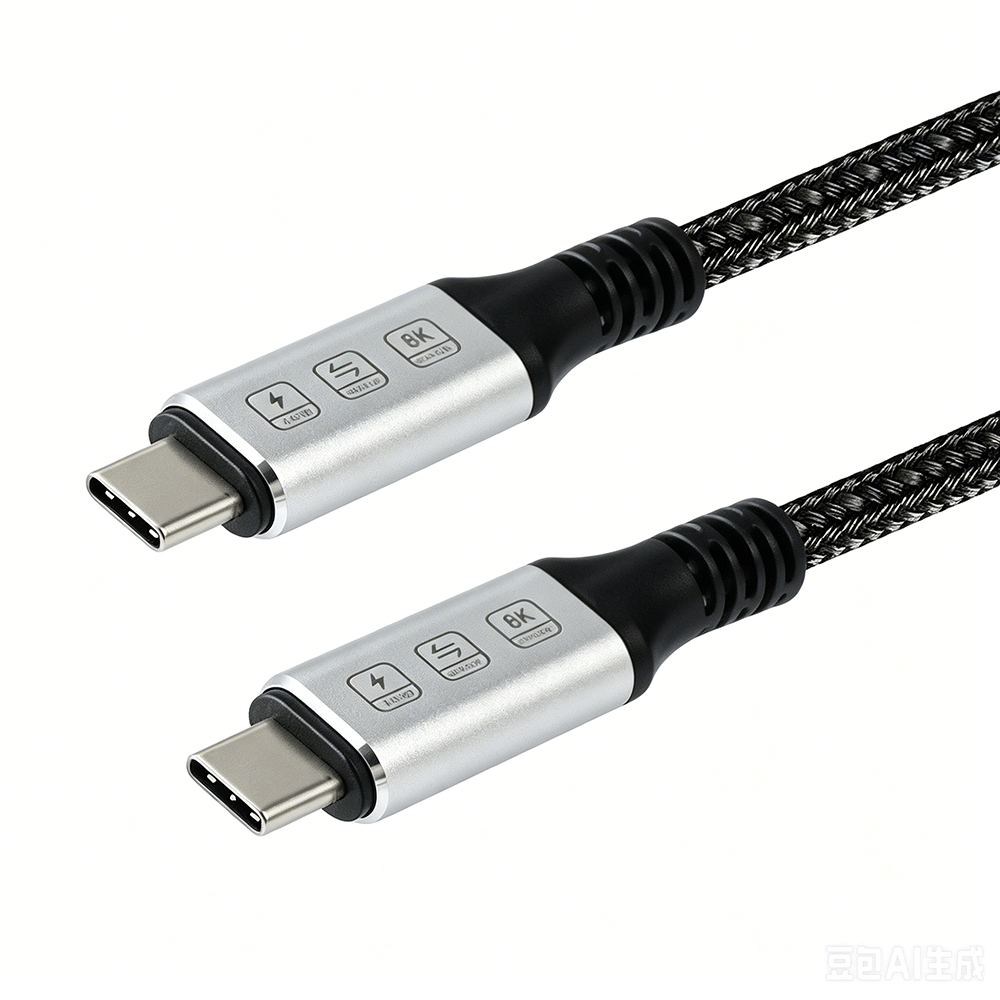
Selecting the correct USB4 cable begins with matching physical layer performance to operational bandwidth requirements.
USB4 specifications utilize dynamic tunneling protocols to allocate bandwidth efficiently across display, data, and PCIe signals. Matching target applications to exact throughput standards prevents overengineering while maintaining signal integrity.
USB4 20Gbps: Supports dual lane architecture for standard office setups, basic peripheral routing, and general desktop connectivity.
USB4 40Gbps: Represents the primary commercial deployment standard, supporting full PCIe tunneling and high refresh rate display setups through certified40Gbps USB Type-C interconnect solutions.
USB4 Version 2.0 (Up to 80Gbps and 120Gbps): Utilizes PAM3 signal encoding to achieve up to 80Gbps bidirectional throughput. For display-centric applications, asymmetric mode allocates three transmit lanes down and one receive lane up to enable 120Gbps video downstream, while capping upstream data at 40Gbps. High speed storage or daisy-chaining deployments require verified bidirectional 80Gbps USB Type-Ccable specifications to ensure symmetrical performance.
Power capabilities must be evaluated independently from underlying data transfer protocols. Modern Type C assemblies support the USB Power Delivery Extended Power Range specification, enabling power transfer up to 240W (48V at 5A) when fully certified.
Sourcing cables for high wattage applications requires verifying conductor wire gauge, isolation shielding, and internal connector thermal design.
Physical Type C form factors should never be confused with underlying protocol functionality. While every USB4 interface uses the universal Type C connector, internal pin mapping, trace layouts, and active component integration vary across product lines.
Enterprise buyers should verify functional pin compliance to ensure seamless fallback compatibility across legacy USB protocols and DisplayPort alternate modes.
Physical cable longevity depends heavily on outer jacket materials, internal conductor shielding, and strain relief construction. Commercial and industrial operating environments dictate distinct material requirements to resist abrasion, chemical exposure, and mechanical flexing.
| Cable Jacket Material | Flexibility | Chemical Resistance | Typical Application Environment |
| Standard PVC | Moderate | Moderate | General commercial and office applications |
| High Grade TPE | High | Good | Mobile equipment and frequently handled accessories |
| Industrial Liquid Silicone | Very High | Excellent | Flexible, high-wear, and demanding environments |
| Nylon Braided Outer Shell | High | Moderate | Applications requiring added surface abrasion resistance |
Selecting specialized outer materials like liquid silicone cable jackets prevents outer shell degradation and ensures flexible cable management in compact workstation layouts.
As physical cable length extends, high frequency signal attenuation and insertion loss become progressively harder to manage. Maintaining signal integrity over longer runs requires precise conductor AWG selection, superior dielectric insulation, and optimized shielding.
Buyers should request validated signal performance test reports for specific target lengths rather than relying on distance metrics alone.
Determining whether passive or active builds fit a project depends directly on transmission distance and signal performance requirements. Passive designs are generally favored for shorter cable runs, while longer or higher performance applications may require active signal conditioning.
Active USB4 cables may incorporate retimers, redrivers, or other signal-conditioning components to compensate for attenuation and maintain signal integrity over extended runs.
Evaluating potential manufacturing partners starts with verifying official industry credentials and environmental safety compliance. Sourcing enterprise interconnects requires verifying independent testing documentation and factory management systems.
Official Certifications: Verification of active USB IF membership, Type C compliance testing, and regional environmental standards including RoHS and REACH.
Quality Management Systems: Active ISO 9001 and ISO 14001 certifications governing raw material inspection through final packaging.
Compliance Documentation: Standardized test summaries validating electrical safety, mechanical endurance, and electromagnetic compatibility.
Procurement managers must verify the E-Marker microcontroller configuration when sourcing Type C cables intended for high speed or high current applications.
Incomplete or incorrect E-Marker configuration can prevent the host and power source from identifying the cable's supported capabilities correctly, potentially resulting in reduced power or feature availability.
Continuous 240W power delivery introduces significant thermal management challenges. Substandard cable builds using undersized ground conductors or poor aluminum connector housings overheat rapidly under maximum load.
Industrial procurement protocols should mandate thermal performance verification across sample batches under continuous specified electrical load.
A qualified manufacturer must maintain comprehensive in house laboratory capabilities to verify every production lot. Essential testing infrastructure includes Time Domain Reflectometers, Eye Diagram test stations, and Automated Insertion Loss analyzers. Accessing established OEM ODM manufacturing services provides direct entry to certified testing facilities and validated production environments.
The inclusion of active signal-conditioning chipsets represents a major cost differentiator in USB4 manufacturing. Active cables require micro-controllers or retimers within the connector housing to maintain bandwidth across extended lengths, increasing Bill of Materials costs compared to passive assemblies.
Conductor purity, shielding density, and jacket polymers significantly impact bulk pricing. Coaxial wiring configurations, silver-plated copper cores, and high-flex liquid silicone jackets command higher manufacturing costs over standard twisted-pair PVC builds due to superior high-frequency performance and extended flex endurance.
Obtaining official USB-IF certification (Test ID validation) involves extensive compliance testing and license fees. While certified cables carry a premium, uncertified bulk lots increase exposure to interoperability failures, safety liabilities, and high return rates in commercial deployments.
A clear inspection framework helps verify that production lots meet applicable engineering and quality requirements before mass production.
Signal integrity should be checked through insertion loss, return loss, crosstalk, and differential impedance testing. Supplier TDR and compliance reports should cover the target cable length and relevant USB4 electrical requirements.
Power delivery verification should cover rated voltage, current handling, and thermal performance under specified USB Power Delivery conditions. For applicable Type-C cables, E-Marker programming should also be checked to confirm reported power and data capabilities.
Mechanical inspection should cover flex resistance, tensile strength, and strain relief performance according to the intended application environment. Supplier test reports can provide evidence that the cable construction meets the required durability level.
Bulk unit pricing is governed by data speed ratings, total cable length, passive versus active signal-conditioning integration, outer jacket material, and official testing certification. Incorporating active chipsets or specialized materials like industrial liquid silicone increases unit manufacturing costs.
Enterprise buyers should request direct quotes based on target volume, custom branding, and technical specifications through verified OEM quotation portals that provide batch-level cost breakdowns.
Prior to finalizing bulk purchase orders, buyers should verify target data rates, power delivery requirements, E-Marker microcontroller programming, jacket material durability, and sample test reports for signal integrity. Auditing the supplier's ISO compliance and USB IF certification further ensures long term quality consistency.
Passive USB4 cables rely entirely on physical copper conductors without inline signal conditioning, making them suitable for shorter reach setups.
Active USB4 cables incorporate retimers, redrivers, or signal-conditioning chipsets inside the connector housings to amplify signals, compensate for attenuation, and maintain full bandwidth over extended cable distances.
Securing reliable USB4 interconnect architectures requires balancing data bandwidth, thermal stability, and rigorous supplier auditing. Enforcing precise compliance verification, selecting environment-appropriate construction, and setting up systematic sample testing allows enterprise procurement teams to mitigate sourcing risks and maintain seamless hardware deployments.
Partnering with an experienced manufacturing specialist provides access to certified designs, custom OEM configurations, and scalable production. Contact the engineering teamto review technical documentation, request evaluation samples, or discuss volume pricing tailored to specific application requirements.



Copyright © 2025 Guangdong Jiumutong Communication Technology Co., Ltd All Rights Reserved
Designed by 


