Manufacturer Of High Quality Data Cable

Manufacturer Of High Quality Data Cable
For procurement managers in high performance computing, sourcing high speed cabling requires balancing unit cost against physical layer performance. Choosing cables without verified signal integrity leads to attenuation, data errors, and costly downtime.
Conversely, precision impedance control ensures link stability across multi gigabit workloads, reducing total cost of ownership.Evaluating these parameters early prevents supply chain quality issues and system delays. Next, let us examine the core technical metrics sourcing specialists must analyze during supplier evaluations.
Signal integrity refers to the quality and clarity of electrical signals as they travel through a cable assembly. In high frequency environments, electromagnetic interference and structural imperfections can degrade the waveform before it reaches its destination.
When signal degradation occurs, system hardware must retransmit data packets, which increases latency and overall energy consumption. Sourcing certified high speed cableassemblies eliminates structural bottlenecks, ensuring low latency and high bandwidth data transfer across server racks and network switches.
Poor signal integrity causes systemic failures, downtime, and expensive warranty claims. Substandard shielding in low-cost cable assemblies leads to operational breakdowns in data center servers and storage arrays.
This triggers tedious troubleshooting, operational delays, and lost revenue. Sourcing teams that prioritize verified signal performance protect their organizations from long-term financial liabilities while ensuring product reliability.
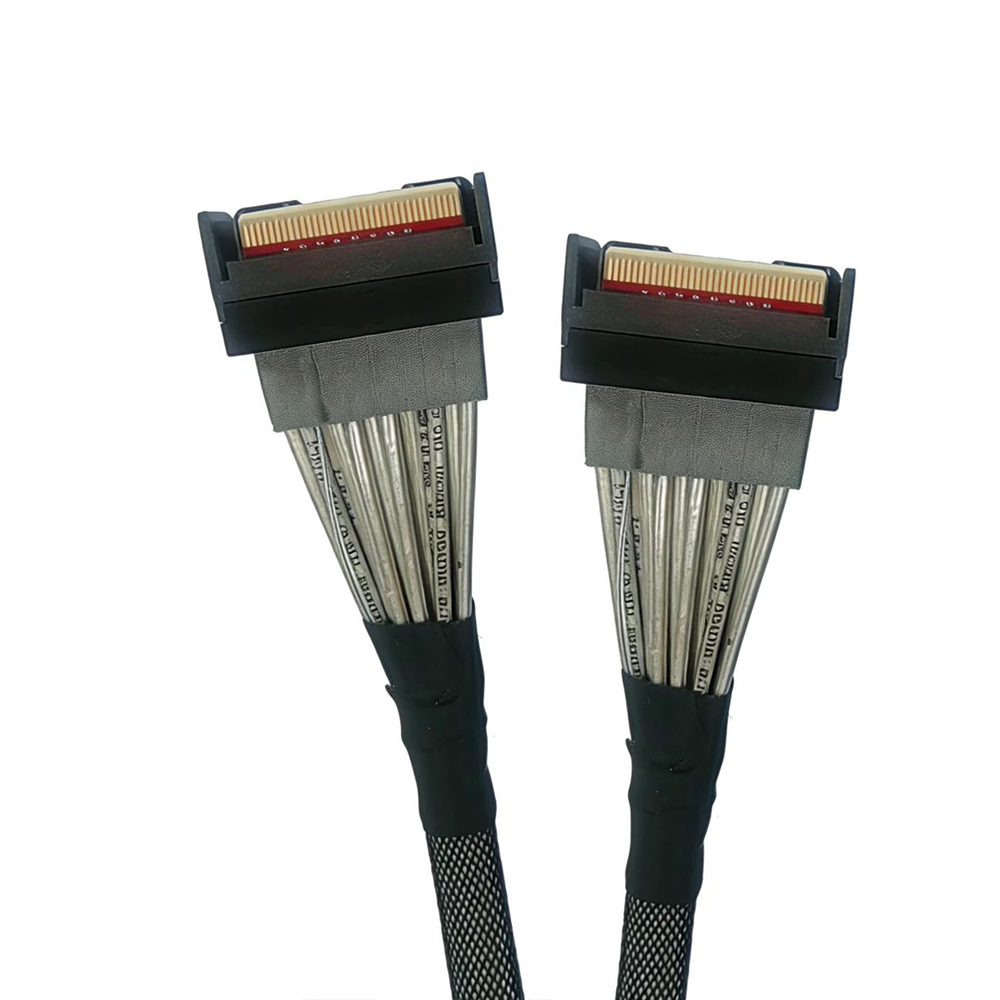
Impedance matching is the primary factor preventing signal reflections inside high frequency cable conductors. Many high speed server architectures use 85 ohm or 100 ohm impedance designs, depending on the interface and system requirements.
When an impedance mismatch occurs at the connector interface, part of the electrical signal bounces back toward the source, causing data corruption. Sourcing teams should evaluate how impedance stability aligns with cable length and attenuation budgets before finalizing purchasing contracts.
Insertion loss measures signal power reduction as electrical signals travel down a cable. Wire gauge directly impacts this attenuation, with thinner 34AWG conductors exhibiting higher loss than thicker 30AWG options over identical distances.
High purity Oxygen Free Copper and fluoropolymer dielectrics like PTFE or FEP minimize these losses, as shown in the baseline technical specs below.
| Cable Type | Supported Protocols | Target Impedance | Data Rates | Typical Applications |
| MCIO Cable | PCIe Gen5, SAS 4.0 | 85 Ohm / 100 Ohm | Up to 32 GT per s | Data Center Servers, RAID Arrays |
| SlimSAS Assembly | PCIe Gen4, SAS 3.0 | 85 Ohm / 100 Ohm | Up to 24 Gbps per channel | Enterprise Storage, GPU Racks |
| USB4 Cable | USB4, DisplayPort | 85 Ohm | Up to 80 Gbps | Workstations, High Speed Peripherals |
| HDMI 2.2 Cable | HDMI 2.2 | 100 Ohm | Up to 96 Gbps | Ultra High Definition AV Systems |
Crosstalk and shielding performance dictate how well a cable resists internal and external electrical noise. Near End Crosstalk and Far End Crosstalk measure signal interference between wire pairs.
Multi layer shielding with aluminum foil and tinned copper braiding blocks noise in dense rack environments, keeping transmission pathways clean under heavy signal loads.Having covered technical metrics, we can now evaluate how cable architectures align with procurement requirements.
Data center and enterprise storage applications demand specialized internal cabling to handle massive throughput. Modern server architectures rely on high-density PCIe Gen5 MCIO cables to support PCIe 5.0 speeds, while cross-protocol platforms use hybrid assemblies to connect motherboard host ports with legacy SAS interfaces. For space-restricted chassis layouts, flexible SlimSAS cables ensure compliant routing without compromising signal clarity.
Commercial workstations and industrial imaging systems rely on high-bandwidth external interfaces. High-performance setups use active or passive USB4 cables supporting up to 80 Gbps and high wattage power delivery, while video and broadcast equipment rely on ultra-high-speed HDMI cables for reliable UHD video passthrough.
Matching interface architecture to operational requirements prevents premature hardware obsolescence.With application guidelines established, let us explore the hidden risks and unseen costs procurement teams face during vendor selection.
Standard factory batch testing often misses subtle signal integrity defects that appear under high frequency operation. Suppliers frequently rely on basic direct current resistance checks instead of complete S-parameter sweeps using Vector Network Analyzers.
A cable passing basic continuity tests can still suffer from severe insertion loss or high jitter at 32 GHz. Sourcing teams must require complete Vector Network Analyzer reports covering differential parameters up to the full operational bandwidth.
Focusing solely on initial unit price creates financial risk across the product life cycle. Substandard dielectric materials or irregular conductor concentricity lead to high bit error rates, forcing servers to run at reduced speeds.
This degradation causes operational inefficiencies, unexpected maintenance, and potential customer churn. Calculating total cost of ownership requires factoring in long term stability, return rates, and warranty expenses alongside the initial quote.
Evaluating factory quality control identifies reliable partners early. Sourcing managers should review supplier systems, verifying ISO 9001 certifications and accredited laboratory testing facilities. Suppliers using automated assembly eliminate human error during delicate stripping and soldering steps.
Establishing strict quality agreements prevents low grade raw material substitutions during mass production.Having identified the main sourcing risks, let us outline the questions procurement teams must ask before finalizing a purchase order.
material quality (silver-plated copper, fluoropolymer dielectrics, advanced shielding), automated precision manufacturing, and mandatory 100% VNA testing for tight impedance control.
Repeated flex stresses internal conductors and shielding, causing mechanical distortion. This shifts the distance between differential pairs, creating impedance spikes, reflections, and signal loss unless high-flex stranded materials are used.
Connectors are the primary point for impedance mismatches. Subpar contacts, loose pin tolerances, or poor solder joints introduce reflection points and packet errors, degrading the entire channel regardless of wire quality.
Cheaper materials exploit the skin effect, where high frequency current travels on the conductor surface. Inferior metals or poor plating increase attenuation, boost thermal build up, and cause intermittent dropouts.
Procurement teams should treat high speed cable sourcing as an engineering decision, not simply a purchasing transaction. Evaluating impedance control, insertion loss, shielding performance, and test documentation helps reduce signal integrity risks, unexpected downtime, and long term replacement costs.
Choosing a manufacturer with automated production capabilities and rigorous quality testing can further improve consistency across large orders. Contact JMTJMto discuss your high speed cable requirements, application specifications, and customized cable solutions.



Copyright © 2025 Guangdong Jiumutong Communication Technology Co., Ltd All Rights Reserved
Designed by 


